Why Your Corporate Event Risks Being Forgotten in 30 Days (and How to Prevent It)
You organize a seminar. The immediate feedback is excellent, the satisfaction survey shows good scores, everyone smiled in the photos.
A month later, what actually remains of the experience?
A few images. One talk. One encounter. One particular moment. And sometimes… almost nothing.
This isn’t necessarily a sign that the event was a failure. It’s also related to how our memory works.
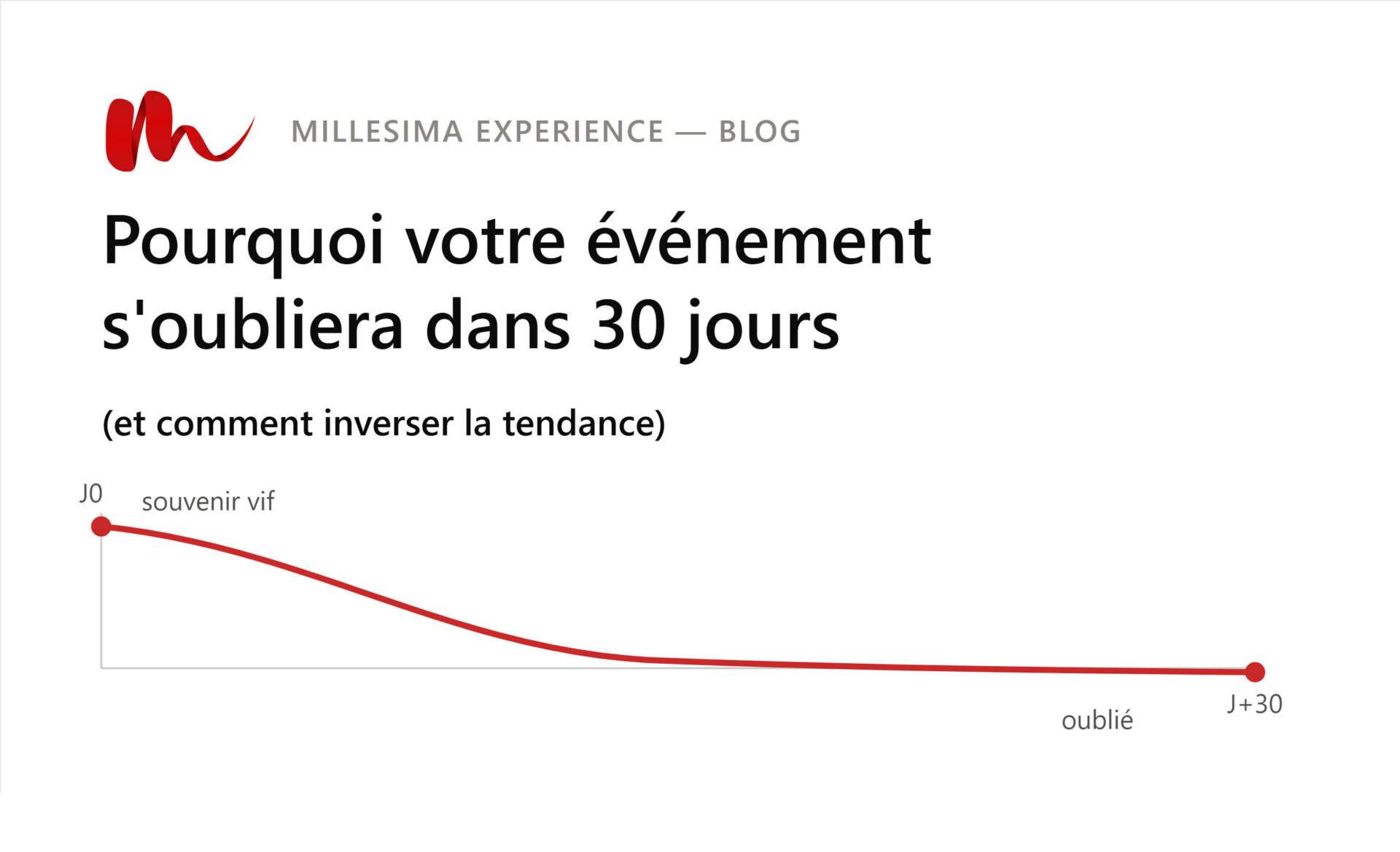
The Forgetting Curve: A Phenomenon Studied for Over 140 Years
As early as 1885, German psychologist Hermann Ebbinghaus published his experimental research on memory and forgetting.
His research showed notably that information learned and then left without repetition becomes progressively harder to recall. His historic experiments gave rise to what we now call the forgetting curve.
Of course, attending a professional event isn’t the same as memorizing the syllable series used in Ebbinghaus’s experiments.
But the principle raises a particularly interesting question for events:
What do we do to make the experience continue to exist in participants’ minds once the event is over?
Because creating a memorable event isn’t just about succeeding on the day itself. You also have to think about what will remain afterward.
What We Actually Remember From an Experience
Another mechanism helps us better understand this phenomenon: the peak-end rule, notably studied by Barbara Fredrickson and Daniel Kahneman.
The principle is simple: when we retrospectively evaluate an experience, certain moments can weigh much more heavily than others in our memory, particularly its peak intensity and its ending. The original 1993 research highlighted this phenomenon, and a 2022 meta-analysis of 174 effect sizes provided strong support for the existence of the peak-end effect.
For events, the consequence is significant.
You can have flawlessly executed staging, eight hours of relevant content, and impeccable organization. But if everything unfolds at the same pace, without a real highlight and with an unremarkable closing, the experience risks leaving fewer traces than you’d expect.
Conversely, an event can create a much stronger memory thanks to just a few particularly well-designed moments.
The question is therefore no longer just: “Is the program good?”
But also: “What do we want participants to remember?”
Why Satisfaction Surveys Only Tell Part of the Story
After an event, we naturally look at the same indicators:
- attendance rate;
- overall satisfaction;
- perceived quality of the talks;
- engagement during sessions;
- participant feedback.
This data matters.
But it mainly measures the immediate experience.
A participant can leave an event very satisfied without necessarily retaining a precise memory of it several weeks later.
That’s the whole difference between an experience enjoyed in the moment and an experience that leaves a lasting mark.
And that’s perhaps where measuring an event’s success needs to evolve: no longer just asking “Did you enjoy it?” but also looking at what was retained, shared, reused, or carried forward after the event.
How Do You Design an Event That Lasts?
Three levers can make a real difference.
1. Create a Genuine Peak
Every event should have a moment that participants can identify almost immediately when asked: “What was THE moment of the day?”
An unexpected talk. A revelation. An immersive experience. A participatory activation. A spectacular staging moment. A particularly powerful encounter.
It’s not necessarily about spending more. It’s about intentionally designing a breakthrough moment.
2. Care for the Ending as Much as the Opening
We put enormous energy into welcoming participants: check-in, badging, staging, music, introduction…
And yet, the ending is sometimes reduced to a few thank-yous, some practical information, and then a gradual dispersal.
That’s a missed opportunity.
If the final moments strongly influence our retrospective evaluation of an experience, the closing deserves to be treated as a genuine part of the event.
A strong conclusion can summarize an idea, evoke an emotion, create one last interaction, or simply make people want to continue the experience.
3. Turn Spectators Into Participants
Watching is not the same as participating.
Asking a question. Making a decision. Voting. Contributing to a discussion. Talking with an expert. Taking part in a workshop.
Interactivity can notably improve engagement in conference and professional learning contexts. For example, a study comparing traditional conferences with formats incorporating multimedia, audience participation, and mentoring found improved engagement and satisfaction in the interactive format.
The event should therefore not simply be something people watch. It should become something they experience.
And After the Big Day?
There remains a limitation, however.
Even the best event ends.
The lights go out. Participants go home. Conversations slow down. The content sometimes just sits in a folder or a link sent by email.
So why treat the end of the event as the end of the experience?
This is precisely the thinking that led us to develop myviOO, a digital platform dedicated to professional and scientific communities.
The goal is to extend the momentum created during the event: allowing members to revisit content, keep interacting, access experts and speakers, and maintain an active community beyond the in-person gathering.
The event then becomes a highlight in the life of a community, rather than an isolated moment on the calendar.
Our Approach at Millesima Experience
At Millesima Experience, we therefore aim to think about events across three timeframes:
- Before, to build anticipation and prepare the experience.
- During, to create the interactions, emotions, and moments that will last.
- After, to extend the value created and prevent all that momentum from disappearing once the event ends.
Staging, content, technology, and activations are ultimately just means to an end.
The real goal lies elsewhere:
creating an experience whose value continues to exist once participants have left the room.
Because a good event shouldn’t just succeed on the day itself.
It should still have an impact 30 days later.